
Conscious Enterprise Management

Research Team: Dr. Sai Susarla, Sri Pratap Hegde, Sri Vinay Kulkarni, Prof. K. Sankaran, Prof. G.P. Sudhakar, Smt. K. Vanaja, and Dr. N.V. Vighnesh
Motivation
Several disruptions have come together to affect the efficacy of how enterprises are managed.
- Environment as a stakeholder: The effect of how enterprises function on the environment has become a significant issue due to the adverse effects on climate.
- Cultural diversity: In an increasingly global marketplace, stakeholders are distributed globally, including employees, customers, investors, suppliers, and governments. Each has cultural values that need to be accommodated for harmonious coexistence.
- Loosely coupled workforce: Employee loyalty to a single company can no longer be taken for granted. Technology has enabled remote work and time-shared services for multiple enterprises at a time, forcing enterprises to rethink terms of engagement and IP protection.
- Broadening of stakeholder value: Wealth is no longer the only motivator for participation in an enterprise. Work-family balance, intellectual satisfaction, community, ethical standpoint, national aspirations, and environmental impact all become important to different stakeholders.
- Non-commercial enterprises: There is a proliferation of enterprises without a profit motive, including social, cultural, political, and spiritual organisations for whom serving a cause is more important than financial self-sustenance. Current MBA programs do not adequately cover the needs of such organisations.
Enterprise management has evolved from managing a large pool of human robots to a dynamic peer-to-peer ecosystem of fully alive participants with their own multidimensional motives and interests. We are approaching the way nature itself operates and must adopt some of its time-tested strategies. At the core of these disruptions lies a marked shift in the notion of stakeholder value beyond wealth, a demand for flexibility and decentralisation in decision-making, and the need to accommodate participants with diverse aspirations and priorities.
To handle these disruptions effectively, we need a new paradigm of management that looks at stakeholders, their identities, and their aspirations more holistically. Management must evolve strategies for handling stakeholders as an ecosystem of peer living entities and motivating them to work together to achieve larger causes while fulfilling their individual aspirations. We need a comprehensive model of stakeholder behaviour that captures multidimensional personality and aspirations, as well as a model of how individuals come together to bring an organisation alive.
How Vedic Wisdom Contributes to Management
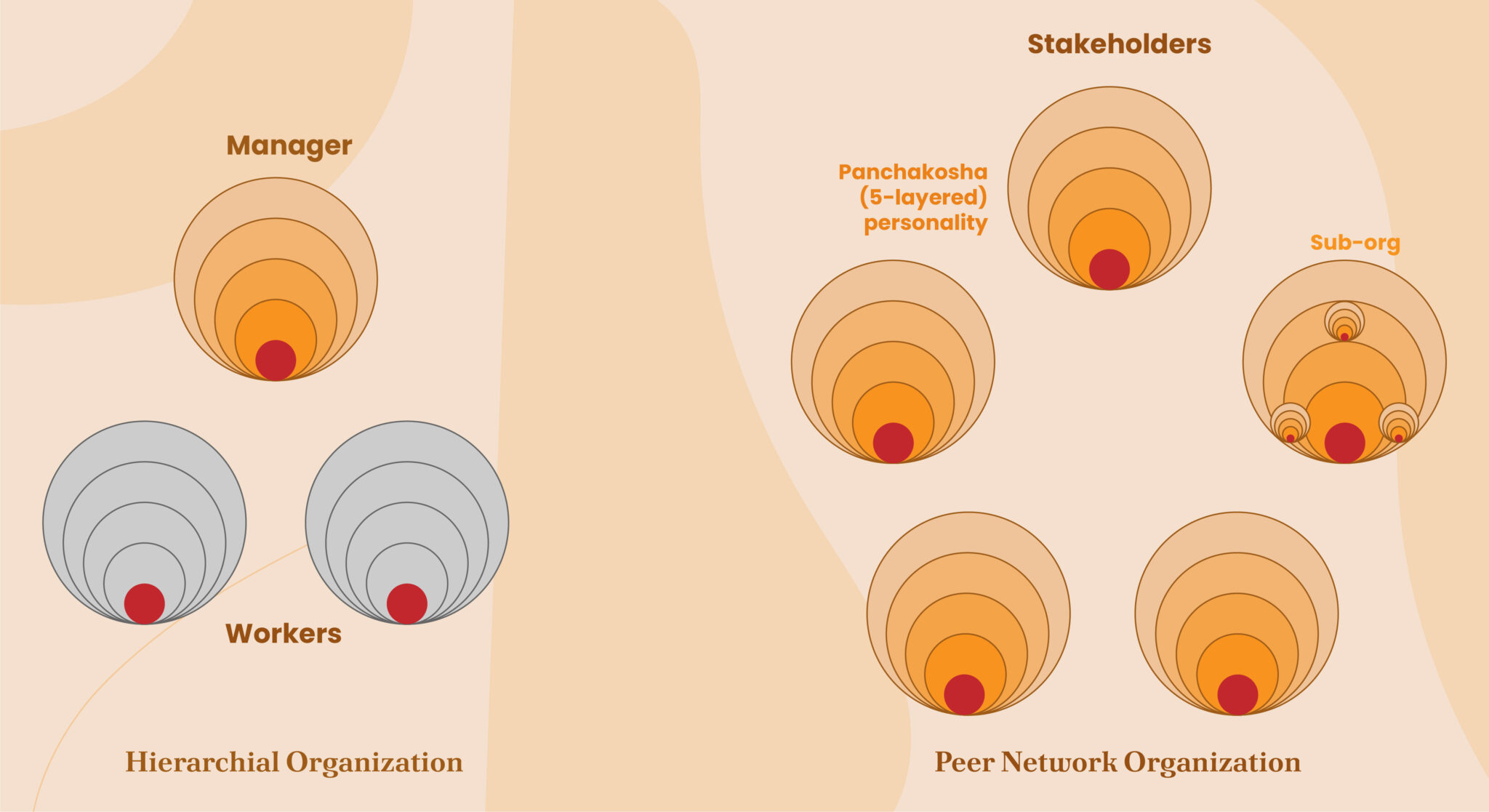
Vedic wisdom offers a comprehensive model of conscious life and its behaviour. This model is inherently recursive or fractal and can be extended equally to organisations and individuals. In this model, both an individual and an organisation can be represented as having pancha koshas, or five layers of personality, with their own unique motives.
This expanded view enables us to model a wide variety of enterprises, not just commercial ones. This includes social, cultural, political, and spiritual organisations. Such a unified model offers a sound basis for reasoning about organisational behaviour and a rich set of strategies for navigating diverse personalities. Since this model throws light on the inner springs of behaviour and makes managers more aware of them, we call the paradigm based on the Vedic model Conscious Management.
Revamping Management Education
To train future managers to navigate the challenges of modern enterprise effectively, we have developed this novel master’s-level management training program that presents the larger context and the principles at work. We introduce the Conscious Management paradigm and its underlying Vedic model, show how it offers new ways of problem-solving, and then introduce the mainstream functional knowledge of management.
Program Objectives
This program is designed with the following outcomes in mind:
- Groom future managers to handle the organisational needs of a wide variety of enterprises, both commercial and non-commercial, Western as well as Bharatiya.
- Inculcate the intelligence necessary to design organisational solutions for dynamic, multicultural, and non-hierarchical environments.
- Provide a comprehensive understanding of the psychology of individuals as well as organisations.
- Empower managers with the skills necessary to deliver sustainable wellbeing as stakeholder value beyond wealth.
Approach
In the first year, the focus is on providing a top-down perspective of the larger organisational ecosystem and its underlying driving factors. We also give specific attention to grooming individual personality and the ability to learn new skills on the go. We believe these are critical capabilities in a rapidly changing social and technological landscape.
In the second year, we introduce functional knowledge of the various departments of enterprise management as traditionally covered. Our approach enables students to appreciate the rationale behind management techniques and judiciously adapt them to changing contexts.
A unique aspect of our program is the introduction of a novel model of individual and organisational behaviour based on Vedic wisdom, showing how it applies across the functions of management. This model can explain the efficacy of both Bharatiya and Western management practices by delving into the universal inner springs of human behaviour.
The courses are divided into five buckets:
- Macro Context
- Firm Context
- Decision-making and Business Models
- Implementation
- Functional Expertise
The following diagram illustrates the overall management architecture covered by this program.

